
Compliance as a False Signal
Why Governance Artifacts Don’t Collapse the Exposure Window

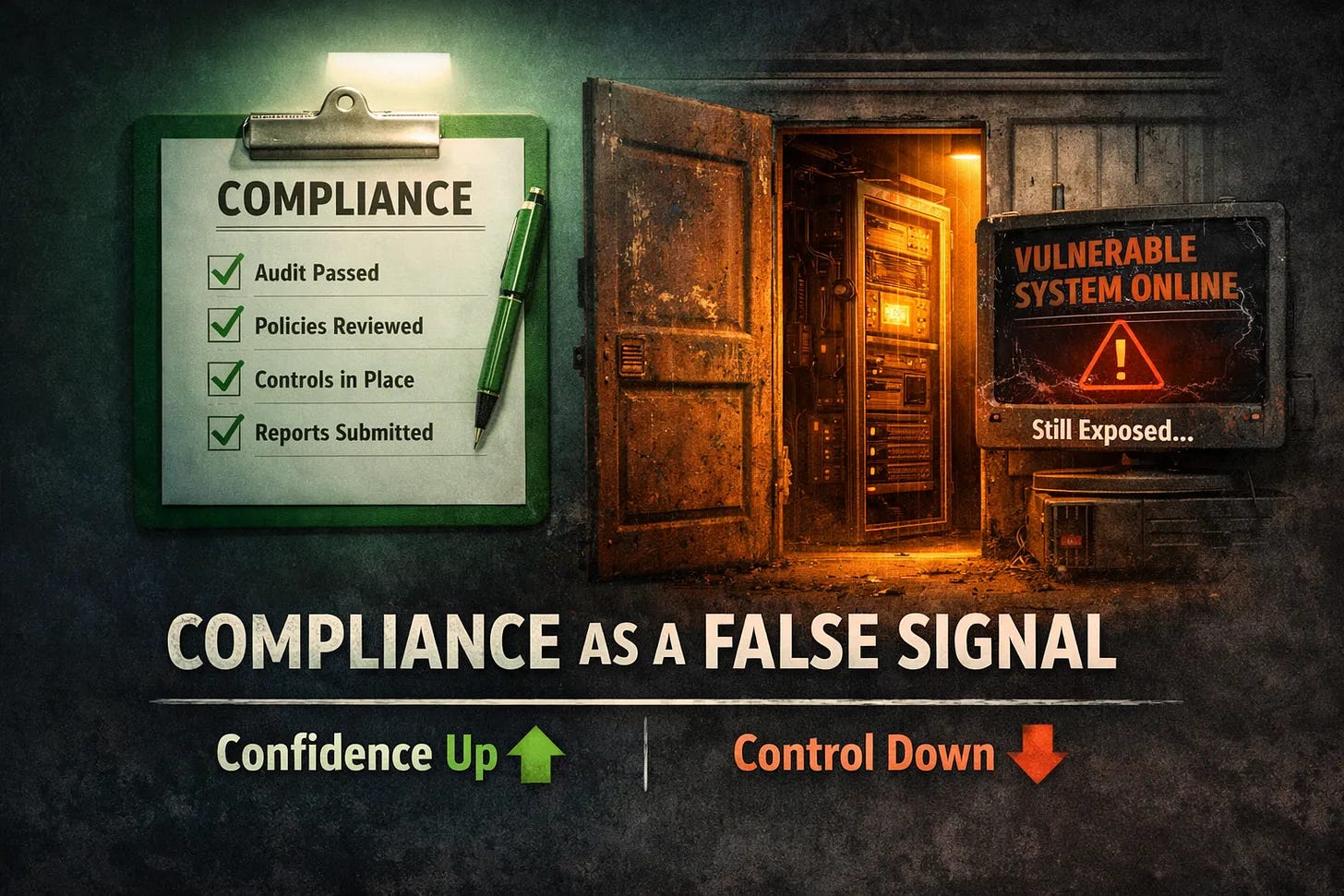
Most organizations that experience a breach were compliant shortly before it happened.
They had passed their audits.
Controls were documented.
Policies were reviewed.
Reports were submitted upward with confidence.
Nothing in the compliance narrative suggested imminent failure.
And yet exposure persisted.
This should make us uncomfortable.
Because if organizations can satisfy formal requirements while externally reachable systems remain exposed for months, then compliance is measuring something other than control. It may validate structure. It may confirm documentation. It may demonstrate operational effort. But it does not necessarily collapse the Exposure Window.
That distinction matters.
Compliance frameworks are designed to answer a specific question: do defined controls exist, and are they operating as intended at a point in time? Evidence is gathered. Screenshots are collected. Access reviews are performed. Exceptions are logged. The organization demonstrates that it is behaving according to a defined model.
This process has value. Without it, governance degrades into improvisation. But compliance measures the presence of process, not the duration of exposure.
An externally reachable asset can remain exposed for six months while still appearing within a compliant system. It may be scanned regularly. Tickets may be generated. Risk may be acknowledged. Meetings may reference it. The exposure is not invisible. It is cataloged.
From a compliance perspective, the system is functioning. The issue was identified. It entered workflow. It was tracked.
From a risk perspective, the door remained open.
Compliance creates reassurance because it transforms uncertainty into artifacts. Once a risk is documented, reviewed, and assigned an owner, it appears governed. The act of formal acknowledgment produces a sense of containment, even if no underlying condition has changed.
But documentation does not reduce reachability. Reporting does not alter configuration. Approval workflows do not shorten duration.
The Exposure Window does not close when a risk is logged. It closes when the condition is altered.
This gap between acknowledgment and alteration is where false signals emerge.
Consider how leadership experiences risk. They receive dashboards, summaries, and compliance attestations. They see trends, maturity scores, and evidence of oversight. From this vantage point, the organization appears controlled. Known risks are known. Unknown risks are being hunted. The machine is operating.
What is rarely visible at that altitude is how long specific exposures have remained externally reachable while internally understood. Duration is not always central to compliance reporting. A control may require that vulnerabilities are assessed monthly or that high-severity findings are remediated within defined SLAs. If those procedural requirements are satisfied, the organization can demonstrate conformity.
But conformity to process is not the same as preservation of optionality.
When an exposure is first introduced, remediation is usually straightforward. The owner remembers why the configuration exists. Dependencies are limited. The cost of reversal is low. The decision space is wide.
As time passes, that same exposure becomes embedded. Other systems integrate with it. Business workflows begin to rely on it. Institutional memory fades. The rationale behind the original decision becomes unclear. Removing it becomes disruptive rather than corrective.
Compliance can continue to validate that the issue is being tracked throughout this entire progression. Reports may reflect awareness. Reviews may confirm acknowledgment. The organization remains aligned with its defined framework.
Meanwhile, the cost of action increases.
This is the false signal: confidence can rise even as reversibility declines.
The longer an exposure persists, the more expensive change becomes. Not necessarily in financial terms, but in coordination, uncertainty, and operational friction. Teams hesitate to act because they no longer fully understand the blast radius. What once could have been corrected in minutes now requires meetings, dependency mapping, and cross-functional approval.
Nothing in the compliance artifact captures this erosion.
Compliance frameworks are not designed to measure decision half-life. They measure whether the system for reviewing risk exists. They do not measure whether the organization still retains low-cost paths to remove it.
This distinction explains why breaches often follow periods of apparent stability. From a governance standpoint, everything appears in order. Controls are operating. Reviews are occurring. Risks are categorized and discussed. The organization is behaving responsibly within its defined model.
But exposure is not governed by meeting cadence. It is governed by time and reachability.
Attackers do not consult audit logs before enumerating services. They observe what is externally accessible and persistent. If a service has been reachable for months, it is functionally equivalent whether it was compliant or not. The external surface does not differentiate between documented and undocumented exposure.
Compliance may reduce certain categories of risk by enforcing consistency and oversight. But it does not inherently shorten exposure duration. It does not guarantee that known conditions are resolved before they become structurally embedded.
This is not an argument against compliance. It is an argument against confusing compliance with control.
Control implies the ability to change conditions before they harden. It implies preserved optionality. It implies that when a risk is identified, the organization can act while the cost of action is still manageable.
When compliance becomes the primary signal of security health, organizations begin optimizing for artifact production. Evidence becomes proof of diligence. Diligence becomes proof of safety. And over time, the presence of documentation can obscure the persistence of exposure.
A risk that is identified immediately and resolved within hours collapses the Exposure Window. A risk that is identified immediately but left reachable for six months remains fully exploitable. From a detection standpoint, both represent success. From a compliance standpoint, both may represent process adherence. From an exposure standpoint, they are radically different.
One preserved control. The other normalized risk.
Security maturity is often framed in terms of coverage, policy alignment, and audit performance. These are tangible and measurable. They create structure and accountability. But maturity that does not account for duration risks becoming theatrical. It demonstrates that oversight exists without revealing whether exposure drift was meaningfully constrained.
The Exposure Window reveals a dimension that compliance alone does not capture: how long the organization allowed a known condition to remain externally accessible while its ability to reverse that condition was gradually shrinking.
Governance, in its deepest sense, is not the act of documenting review. It is the preservation of decision space before that space collapses.
When exposure persists long enough, removal becomes negotiation rather than correction. At that point, the organization has not merely accumulated risk; it has surrendered flexibility.
Compliance may still appear healthy in that moment. Dashboards may still trend favorably. Reports may still reassure.
But control has already narrowed.
If security programs want to understand whether they are truly managing exposure, they must look beyond whether risks were cataloged and toward how long they remained reachable while known. Without that dimension, compliance can function as a mirror that reflects order while obscuring drift.
The difference between oversight and control is time.
And time does not appear in most compliance artifacts.