
Exposure Half-Life
How long does risk actually live in your environment?

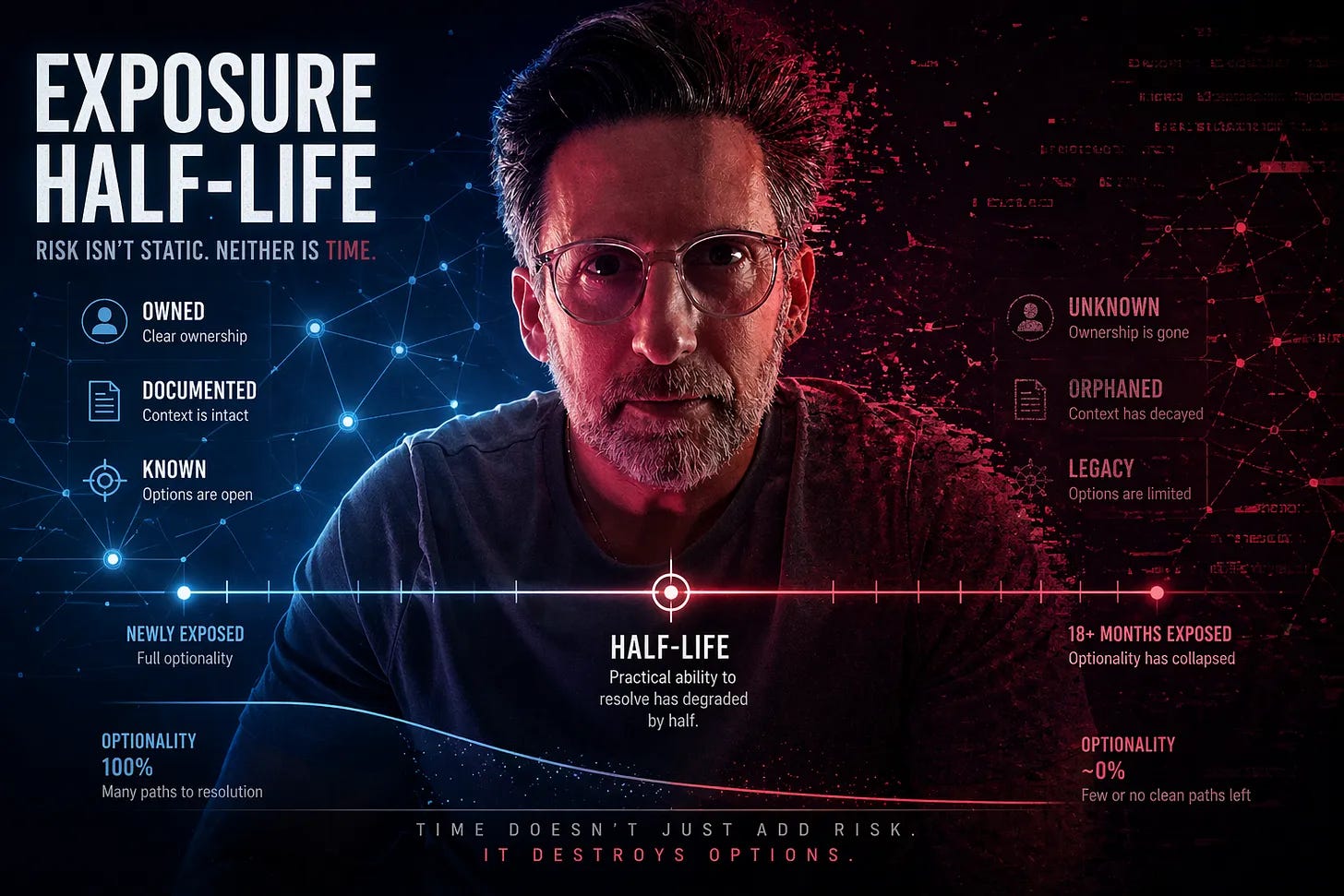
Not all exposure is the same age.
A service exposed for three days and a service exposed for three years will appear identically on most security reports. Same finding type. Same severity score. Same checkbox on the dashboard. The model treats them as equivalent problems requiring equivalent urgency.
They are not the same problem.
Something changes when exposure ages. Not the vulnerability itself, but the condition around it. Dependencies form. Teams change. Documentation decays. The engineer who built the system moves to a different role. The ticket that explained its purpose gets closed and archived. The context that made the exposure legible; who owns it, what it connects to, what would break if it were removed quietly dissolves.
What remains is the artifact: still visible, still reachable, still responding to requests from the internet. But now surrounded by uncertainty that was not there on the day it was created.
Age does not just accompany exposure. Age transforms it. And until security models account for that transformation, they will keep misreading the actual condition of the environments they’re supposed to be protecting.
* * *
Every risk model in common use treats exposure as a static condition.
A CVSS score measures the severity of a vulnerability at a point in time. A scanner report flags what exists today. A dashboard displays open findings sorted by criticality, with no reference to how long any of them have been open. The color is red or orange or yellow. The age is invisible.
This is not an oversight. It reflects a foundational assumption embedded in how security risk has been modeled for decades: that the danger of an exposure is a function of what it is, not how long it has been there.
That assumption is wrong, and the consequences of it compound quietly, in every environment, every day.
When duration is invisible in the model, it goes unmeasured. When it goes unmeasured, organizations make decisions as if a finding from yesterday and a finding from fourteen months ago carry the same weight, the same urgency, and the same field of available responses.
They don’t.
The fourteen-month finding exists in a fundamentally different context than the one created yesterday. The team that built the underlying system may have changed twice. The original access request may be buried in a ticketing system no one actively monitors. Three other services may have quietly developed dependencies on the exposed component; dependencies that nobody documented, that no tool tracks, that exist only in the working memory of engineers who may or may not still be with the organization.
Resolving the fourteen-month exposure is not the same task as resolving the one from yesterday. It is a more complex task, a riskier task, and a more expensive task. And it becomes more so with every week that passes without action.
The model that ignores age is not measuring risk. It is measuring a snapshot of conditions while the most important variable (time) runs silently in the background, doing its work.
* * *
There is a concept from physics that captures this precisely.
Radioactive decay describes the rate at which an unstable element loses its activity over time. The half-life of a substance is the point at which half of its original activity remains. It is not a measure of whether the substance is dangerous; it is a measure of how long the danger persists, and how much of it is left at any given moment.
Exposure has a half-life.
Not in the sense that the exposure itself becomes less severe over time such as, a misconfigured service exposed to the internet does not become safer because it has been exposed for longer. The half-life of exposure is the rate at which the organization’s practical ability to resolve it degrades.
A newly created exposure exists in a rich field of options. Ownership is clear. Context is intact. The cost of remediation is low. The path forward is clean. That field is not permanent.
As time passes, options close. Dependencies form around the exposed asset. Other systems begin assuming its presence. Teams change and institutional memory fades. The risk of touching it rises; not because the exposure is worse, but because the consequences of getting the remediation wrong have multiplied. What was once a thirty-minute fix becomes a project. What was a project becomes a risk accepted because no one can agree on what resolving it would break.
Half-life is the point at which that degradation becomes consequential. The moment the organization crosses from a rich field of clean options into a narrowed one where every available response carries meaningful cost or risk.
This is not linear. Some exposures degrade quickly — assets in fast-moving environments, systems with dense undocumented dependencies, teams with high turnover, infrastructure deployed in the margins of normal provisioning processes. Others degrade slowly. But all of them degrade. And the half-life clock starts the moment something becomes externally visible… not the moment anyone notices.
That last point deserves to be stated clearly.
The clock does not start when the finding appears on a dashboard. It does not start when a scanner flags the asset. It starts when the asset becomes reachable, which may have happened weeks, months, or years before any internal system registered its existence. The organization has been losing optionality the entire time. The dashboard just made the loss visible.
* * *
If exposure has a half-life, then the metric that matters is not severity alone.
It is age.
Not age as a secondary filter applied after severity ranking. Age as a primary dimension of risk, one that reshapes the meaning of every other signal in the model.
Consider what this changes.
A critical-severity finding discovered this morning represents significant potential impact. But the organization’s ability to respond to it cleanly is at its peak. Ownership is likely known. Context is likely intact. The remediation path, however complex, has not yet been complicated by the passage of time.
A medium-severity finding that has been open for eighteen months is a different kind of problem entirely. The potential impact may be lower on paper. But the organization’s ability to resolve it cleanly may have degraded to the point where the practical risk of carrying it forward exceeds the theoretical risk of the finding itself. The options have narrowed. The cost of action has compounded. The exposure has aged past the point where the original risk score means very much at all.
A security program that measures age alongside severity is asking a fundamentally different set of questions than one that does not.
It stops organizing work around the newest findings and starts surfacing the oldest ones because those are the exposures where the decision window is narrowest, where the cost of continued inaction is highest, and where the gap between what the model shows and what the organization can actually do has grown widest.
It stops asking: how severe is this?
It starts asking: how much time is left?
These are not equivalent questions. Severity describes what an exposure could do. Age describes what the organization can still do about it. Both matter. But only one of them changes every day; whether anyone is watching or not.
* * *
The implication that follows from this is one that most security programs have not yet confronted directly.
Every day an exposure goes unresolved, the organization pays a cost. Not a visible cost, no alert fires, no incident is logged, no report changes color. But a real cost, paid in the options that quietly close, the context that silently decays, the dependencies that form without documentation, the institutional memory that disperses as teams change.
This cost is not recoverable. Options that close do not reopen. Context that decays does not regenerate. The organization that discovers a three-year-old exposure does not get back the two and a half years during which resolving it cleanly was still possible.
What they get is the exposure as it exists now — aged, encrusted with dependencies, stripped of context, surrounded by uncertainty about what acting on it would break.
That is what half-life means in practice. Not that the danger fades. That the ability to respond cleanly does.
And if the ability to respond is itself a resource, one that depletes with time, that cannot be replenished once spent, that determines not just whether an organization can fix a problem but whether it can fix it without creating new ones then the security program that fails to track it is not measuring its most important asset.
The programs that understand this stop asking whether they are exposed. They start asking how old their exposure is because that is the number that tells them not what the risk is, but what they can still do about it.
That is a different kind of security program.
And it begins with a different kind of measurement.
Richard La Bella
Richard is the founder of WatchGate (watchgate.io), an external attack surface and exposure drift monitoring platform built for regulated small businesses.