
How Exposure Is Created (Without Anyone Noticing)
Why Exposure isn't created by failure. It's created by success. Most security failures begin long before the incident.

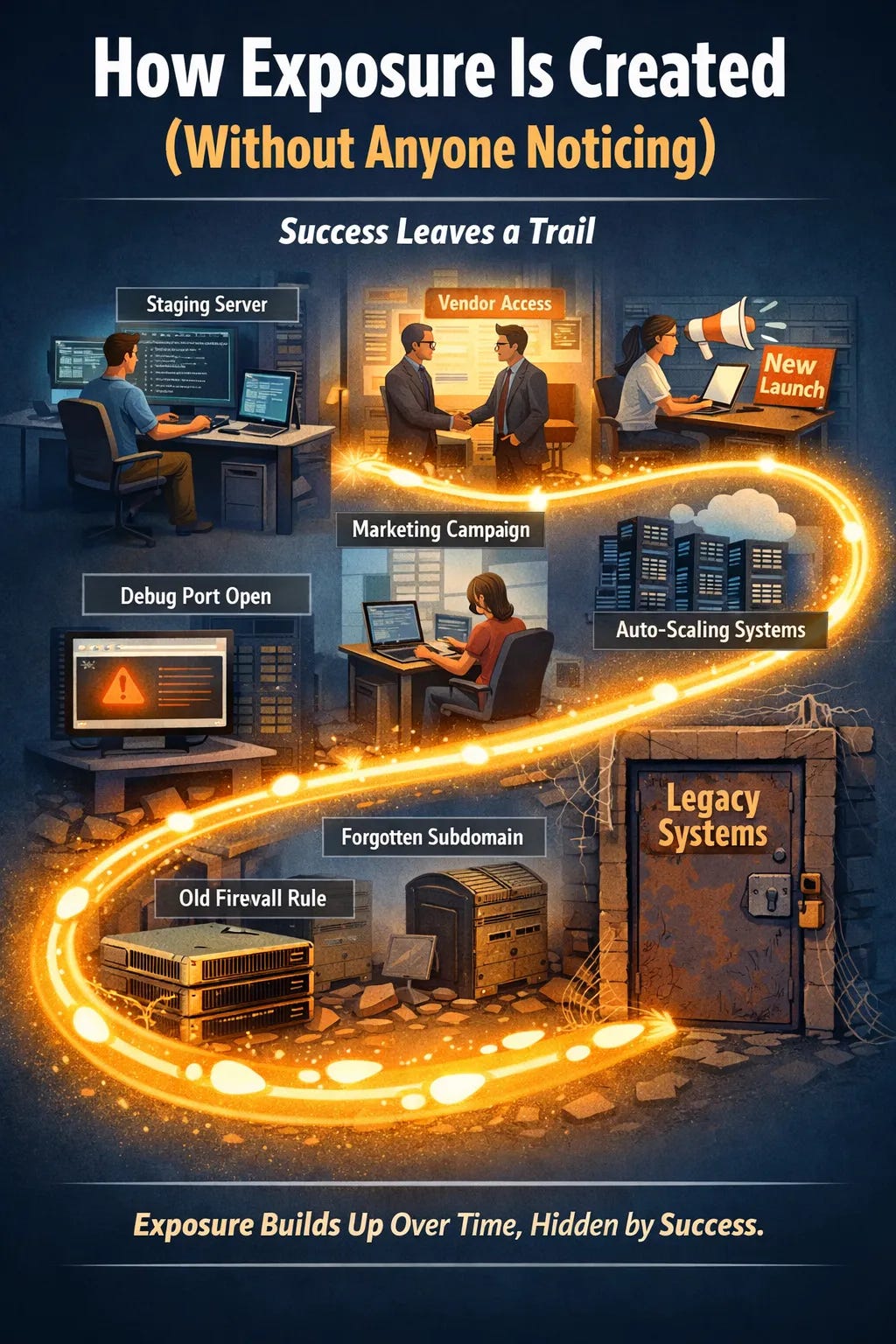
Every organization has assets no one remembers deploying. Systems that exist because they were never removed, not because they were planned. Access that persists because closing it required a decision no one made.
These are not failures of discipline. They are the natural residue of speed, complexity, and the quiet assumption that someone else is tracking what remains.
The uncomfortable truth is that most exposure is created by people doing their jobs correctly.
A staging environment gets spun up because the team needs to test before launch. A firewall rule opens because a vendor needs temporary access. A subdomain points somewhere new because marketing has a campaign. A debug endpoint stays enabled because the issue might resurface. None of these decisions feel risky at the time. They feel productive. They solve problems. They keep things moving.
And then time passes. The project ships. The vendor engagement ends. The campaign concludes. But the artifacts remain. Not because anyone decided they should, but because no one decided they shouldn’t.
This is how exposure actually accumulates. Not through recklessness, but through the absence of a forcing function to revisit what was created.
Security models tend to treat exposure as the result of error. A misconfiguration. A policy violation. A lapse in judgment. The response follows predictably: more training, tighter controls, better enforcement.
But this framework misses the actual mechanism.
Exposure is not created in moments of failure. It is created in moments of success. A deadline gets met. A problem gets solved. A system performs exactly as designed. The infrastructure that made it possible stays running. The access that enabled the fix stays open. The temporary becomes permanent not through neglect, but through the quiet continuation of something that was never scheduled to end.
Security sees exposure as deviation from the plan. In practice, exposure is accumulation alongside it.
Five patterns account for most of what organizations do not realize they have made visible.
The first is the temporary that becomes permanent. Staging environments, debug endpoints, vendor access, test configurations. Nothing temporary is scheduled for removal. It simply stops being actively thought about. The word “temporary” describes intent, not duration. And intent fades faster than infrastructure.
The second is the handoff that loses context. An engineer leaves. A project concludes. A team reorganizes. The systems remain, but the narrative explaining them disappears. Ownership becomes ambiguous. Purpose becomes unclear. What was once deliberate becomes legacy; still running, no longer understood. The person who could explain why it exists is gone, and the documentation, if it ever existed, no longer matches reality.
The third is automation that outpaces understanding. Pipelines create resources. Templates replicate environments across regions. Auto-scaling spawns instances in response to load. Infrastructure now creates itself. The original deployment was intentional. The sprawl was not. No one explicitly approved what now exists, because no one explicitly created it. The system did what it was designed to do, and in doing so, expanded the footprint beyond what any individual can fully map.
The fourth is the edge that escapes the center. Marketing launches a microsite through a third-party platform. Sales enables a new integration without involving IT. A developer uses a personal cloud account to prototype something quickly. A business unit adopts a SaaS tool that exposes an API no one reviewed. Exposure is created by people who do not think of themselves as creating exposure, and who operate entirely outside the visibility of those responsible for managing it.
The fifth is the default that no one questions. A cloud resource deployed with public access because the template allowed it. A service bound to all interfaces because the documentation example did it that way. An S3 bucket left open because the original use case required it and no one revisited the configuration afterward. Exposure baked into the starting point, inherited rather than chosen. The decision was made long before the deployment, by someone who never anticipated this context.
None of these patterns require negligence. None require malice. All of them require only the passage of time and the absence of a reason to look again.
If exposure is created by normal work, then security cannot prevent it through enforcement alone. The problem is not that people break rules. The problem is that nothing in the system asks the questions that matter:
Why was this created?
Who approved it?
What was the original constraint?
When was it supposed to end?
These questions have answers at the moment of creation. The engineer who spun up the environment knows why. The manager who approved the access knows the scope. The team that launched the service knows what it was for.
But answers are not preserved. They live in memory, in Slack threads, in tickets that get closed and archived. Over time, the context decays. What remains is the artifact: still visible, still reachable, still responding to requests from the internet. No longer anchored to intent.
This is the loss of narrative. Not a dramatic failure of process, but the slow erosion of the context that makes assets legible to the people responsible for them.
An asset without narrative is an asset without accountability. It exists, but no one can say confidently whether it should. It runs, but no one remembers what would break if it stopped. It is exposed, but no one realizes the exposure is theirs to manage.
Exposure persists not because organizations are careless, but because nothing forces them to remember. No alert fires when context decays. No dashboard shows the drift between what was intended and what now exists. No workflow triggers when ownership becomes ambiguous.
And in that gap — between creation and forgetting — the Exposure Window opens silently.
The systems are functioning. The work continues. The organization moves forward. Somewhere, invisibly, something is now visible that was not meant to be. And the clock that matters most has already started.
Richard La Bella is the founder of WatchGate, focused on external attack surface visibility for small businesses. This is the fifth paper in The Exposure Window series.