
The Dimension That Wasn't Measured
Why exposure has always been a story about time.

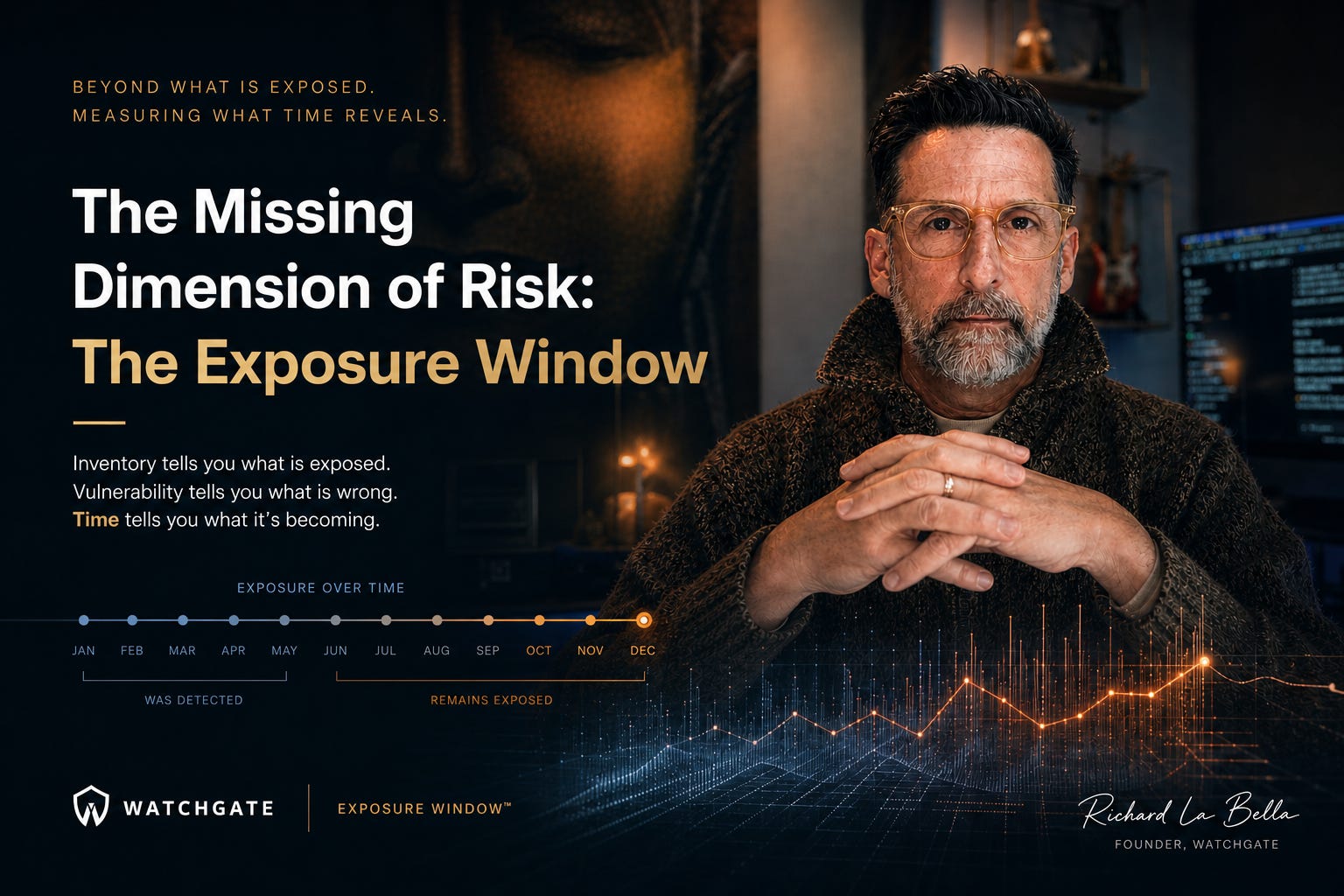
For most of the last decade, the security industry has organized itself around two questions about the external attack surface.
What is exposed? And what is wrong with it?
These are the questions discovery tools answer. They map what is reachable from the outside, identify what is running on those reachable services, and surface what is misconfigured, outdated, or vulnerable. They produce inventories, scores, and dashboards. They generate findings, tickets, and remediation queues. The discipline that grew up around these tools; known variously as external attack surface management, exposure management, or perimeter visibility has, by any reasonable standard, matured. It is real work. It surfaces real problems.
But there is a third question that has gone almost entirely unasked, and the absence of it explains a great deal about why so many breaches still arrive as surprises.
How long has this been the case?
Not when was it first detected. Not when was it last scanned. Not when was the ticket opened. The simpler, harder question: for how long has this thing been reachable, in this state, to anyone outside the organization who was looking?
This question is rarely asked because the tools that produce the answers were not built to answer it. They were built to produce snapshots. Each snapshot is reasonably accurate. Each comparison between snapshots produces a delta. But a sequence of snapshots is not the same as a continuous record. It is a series of moments, stitched together to imply motion. And motion is precisely what exposure does over time. Slow, often invisible, often unattended.
The result is that organizations have learned to talk about their attack surface in the language of what and how much, and have almost no vocabulary for how long. A finding is reported with a severity score, a vulnerability identifier, an asset name. It is rarely reported with a duration. When durations are mentioned at all, they tend to refer to the response window; time to detect, time to patch, time to acknowledge rather than the exposure window itself.
This is a strange omission, because the exposure window is the dimension that determines whether the rest of the story matters.
A vulnerability that was reachable for forty-eight hours and then closed is one kind of risk. A configuration that has been reachable for fourteen months, drifting in small ways the entire time, owned by no one currently employed, watched by no scanner that knows to ask the duration question… that is a fundamentally different kind of risk. The technical findings might look identical at the moment of measurement. The histories behind them are not.
The longer something has been exposed, the more the conditions around it have shifted. The original author has moved on. The constraint that justified its existence has been forgotten. The systems that depend on it have changed in ways no one has reconciled. The external observability of it has only deepened; more scans, more passive datasets, more time for someone outside to notice. Everything about its risk profile has aged, and almost none of that aging has been captured in the inventory.
This is the dimension the industry has been operating without.
Two-dimensional measurement is sufficient for static problems. If the attack surface were a stable thing, fixed in shape, fixed in composition, then knowing what is exposed and what is wrong with it would constitute the whole picture. The problem is that the attack surface is not static. It accumulates. It drifts. It ages. The composition of it next month will differ from the composition of it this month, not because anyone made a deliberate decision to change it, but because the underlying conditions - people, ownership, dependencies, context - are themselves continuously shifting.
A measurement frame that does not include time cannot describe what is actually happening. It can only describe what is true at the moment of measurement, which is a smaller and smaller subset of what matters as the environment ages.
Consider what happens when this dimension is left unmeasured.
The same exposure can appear in three consecutive monthly reports, flagged with the same severity, and be perceived each time as the same finding, when in reality it is a finding that has now persisted for a quarter, has had three months to be observed externally, and has accumulated three months of organizational forgetting. The numerical severity has not changed. The actual risk has compounded. But the measurement frame has no way to express that compounding, because the frame was never built around duration.
This is how exposures persist in plain sight. It is not because no one saw them. It is because no one was asked to see how long they had been there.
The implication is straightforward, even if its consequences are not. Risk is not only a property of the technical state of an asset. It is also a property of the relationship between that state and time. How long the state has held, how much the surrounding context has decayed during the holding, how observable the state has been to outsiders during that period. None of these things are visible without a temporal record. None of them can be inferred from a snapshot, no matter how detailed.
What this suggests is that the question security has been asking; what is exposed? was never the complete question. It was the part of the question that fit inside the tools available to ask it. The other part, the part the tools were not built to capture, is the part that determines almost everything about how exposure becomes breach.
How long has this been the case?
It is a question the inventory cannot answer. It is a question the dashboard does not include. It is a question that, when asked aloud in most security operations centers, produces a pause, and then, often, a search through old tickets, old emails, old change logs, in an attempt to reconstruct a timeline that should already exist as a continuous record but does not.
That pause is the shape of the missing dimension.
Once it is named, it does not unname itself. The pattern shows up everywhere in post-mortems where the exposure is found to predate the breach by months or years, in audits where the same finding has appeared in the same form for three consecutive cycles, in the strange institutional silence that surrounds long-lived exposures whose original justification has been lost. Each of these is the same thing seen from a different angle. They are all consequences of measuring an environment that moves through time using instruments that only measure points in time.
The breach, when it arrives, will be reported in the language the tools are built to produce. A vulnerability. A misconfiguration. A reachable service.
The cause will be in the language no one was measuring.
Not what was exposed.
How long it had been.