
What the Exposure Window Really Is
Why Time, Not Attack, Defines Modern Security Risk

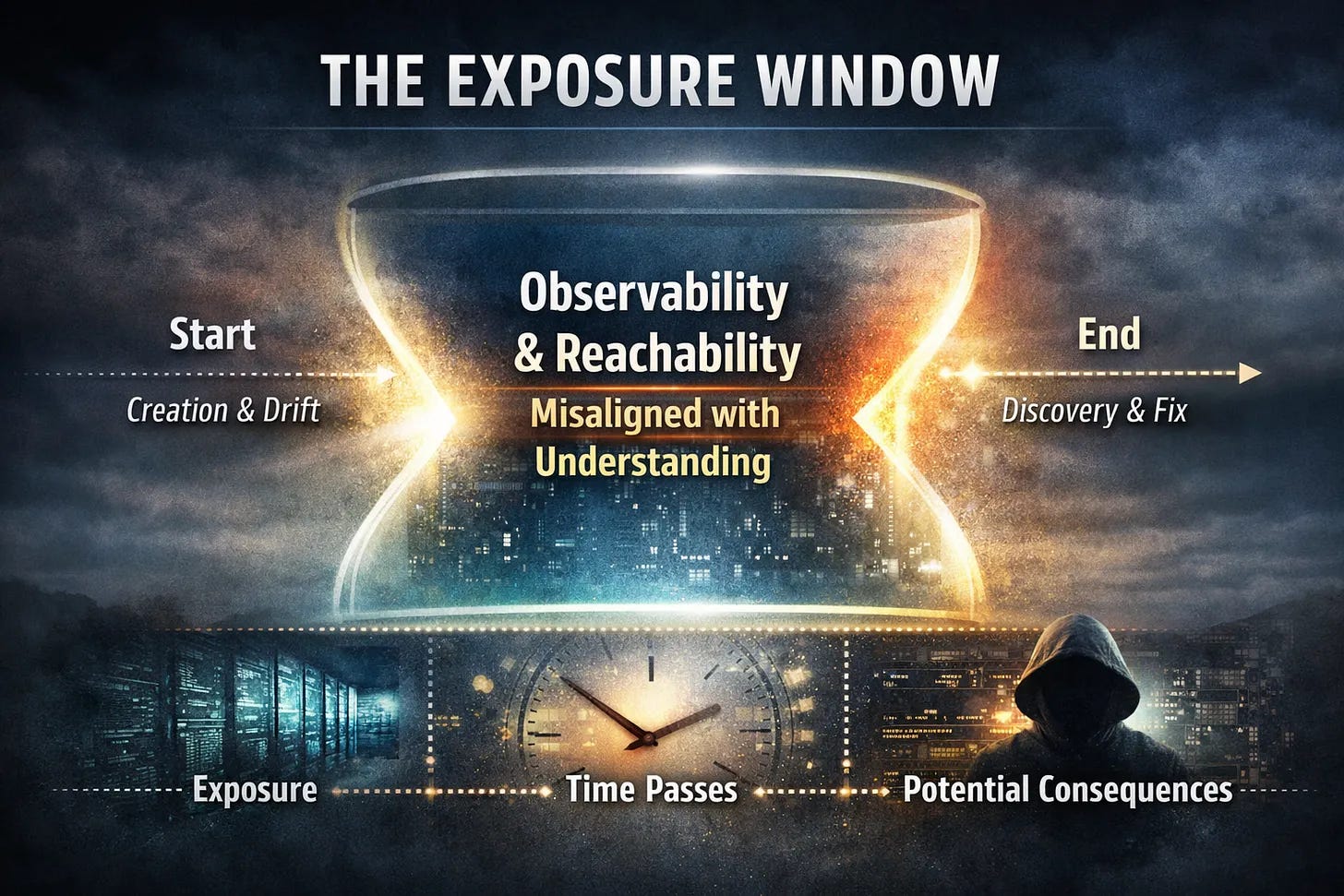
Most security incidents feel sudden. A dataset appears on a forum. An access key is abused. An internal system is discovered exposed to the internet. The narrative usually begins at the moment of discovery, then moves backward to explain how it happened and forward to explain what was lost.
Yet the unease many experienced security leaders feel does not come from the incident itself. It comes from a quieter realization:
This condition existed long before we noticed it.
Weeks passed. Sometimes months. Occasionally years. Nothing happened until something did. That unexamined span of time is not incidental. It is the defining feature of modern security risk.
The Problem With Event-Based Security
Security is still explained as a sequence of events.
A vulnerability is disclosed.
A scan runs.
An alert fires.
An incident occurs.
These moments are discrete, timestamped, and easy to narrate. They fit dashboards, audits, and postmortems. They allow organizations to speak confidently about what they “knew” and when they “knew it.”, but real environments do not operate as a series of moments. They operate continuously.
Access persists.
Configurations drift.
Resources outlive their purpose.
Visibility remains after ownership fades.
The prevailing security model compresses this continuity into snapshots. Discovery becomes awareness. Remediation becomes resolution. Time, when acknowledged at all, is reduced to how long an attacker remained undetected after compromise. This is why incidents feel inexplicable in hindsight. Not because signals were absent, but because duration was never modeled.
A Formal Definition
The Exposure Window is not a metaphor. It is a condition with boundaries.
The Exposure Window is the period of time during which a resource exists in a state of observability or reachability that is misaligned with the organization’s current understanding or intent.
This definition is intentionally indifferent to outcomes. The Exposure Window begins when exposure exists, not when it is discovered. Discovery does not open the window; it reveals that it has been open. The Exposure Window ends when the condition changes, not when a scan completes, a ticket closes, or documentation is updated. The Exposure Window exists regardless of intent, awareness, or consequence. No attacker is required. No failure is necessary. Exposure is a state, not an event.
A Necessary Clarification
When an Exposure Window exists, it necessarily creates the possibility of external observation or interaction. An exposed resource that is reachable or observable is, by definition, available to anyone capable of finding it. However, adversary interaction does not define the Exposure Window. It is merely one of its potential outcomes. Exposure is real even if no one ever scans it, indexes it, or exploits it. Attackers benefit from exposure, but they do not create it. Time does.
This distinction matters because it separates the existence of risk from the moment of harm.
How Exposure Is Actually Created
Most exposure is not created by negligence. It is created by normal work.
A resource is deployed for a valid reason.
Access is granted temporarily.
A configuration is adjusted to meet a deadline.
Visibility is left in place “just in case.”
At the moment of creation, ownership is clear and intent is sound. At that moment, the resource is not yet a risk. Then time passes. Projects conclude. Teams change. Assumptions age. The environment continues to function, but the narrative explaining why it exists decays quietly.
What remains is misalignment: a resource that is still real, still reachable, still observable, yet no longer anchored to an accurate mental model. This is where exposure lives.
Exposure Is Temporal
Traditional risk models emphasize severity: how damaging something would be if exploited.
The Exposure Window introduces a different axis: duration.
A severe vulnerability that exists briefly is categorically different from a moderate exposure that persists indefinitely. Yet most scoring systems treat duration as secondary or ignore it entirely.
Time alters risk without altering the resource. As exposure persists, observability increases, correlation becomes possible, and assumptions fail silently. Nothing in the environment needs to change for risk to compound. Time alone is sufficient.
This is uncomfortable because time cannot be assigned ownership. No one causes it. No tool naturally reports on it. Yet it is the most consistent amplifier of exposure.
Exposure Does Not Imply Fault
Security conversations often assume that risk implies failure. The Exposure Window rejects this assumption. Exposure does not require negligence, policy violations, malicious intent, or control failure. It requires only that reality drift from belief.
A system can be deployed correctly, approved appropriately, and documented accurately and still represent exposure if the assumptions surrounding it are no longer true. This is why post-incident narratives focused exclusively on “what went wrong” feel incomplete. Often, nothing failed at the moment that mattered. What failed was continuity over time.
Exposure Precedes Consequence
Exposure can persist without incident. This does not make it harmless. It makes it latent. The absence of consequence is not evidence of safety; it is evidence that nothing has intersected with the condition yet. If awareness only arrives at exploitation, maturity is indistinguishable from luck. If awareness arrives while exposure is still merely a condition, maturity becomes observable.
The Exposure Window does not predict attack. It explains why an attack, when it occurs, rarely feels surprising.
What This Forces Us to Admit
Once exposure is understood as temporal, several familiar ideas destabilize.
Discovery is not controlled.
Severity without duration is incomplete.
Prevention delays exposure; it does not eliminate it.
Security maturity can no longer be defined by the absence of incidents. It must be defined by how quickly exposure collapses; how short the window remains open between creation and understanding. This is not a call for perfection. It is a call for accuracy.
Naming the Condition
The Exposure Window is not a tactic, a metric, or a category. It is a way of naming a condition that has always existed but rarely been acknowledged. Once named, it becomes difficult to ignore.
It explains why confidence often precedes surprise.
It explains why incidents feel inevitable rather than accidental.
It explains why time, not attackers, is the most reliable amplifier of risk.
Security has spent decades refining how to see what exists. The Exposure Window asks a harder question:
How long has this been true without being understood?